
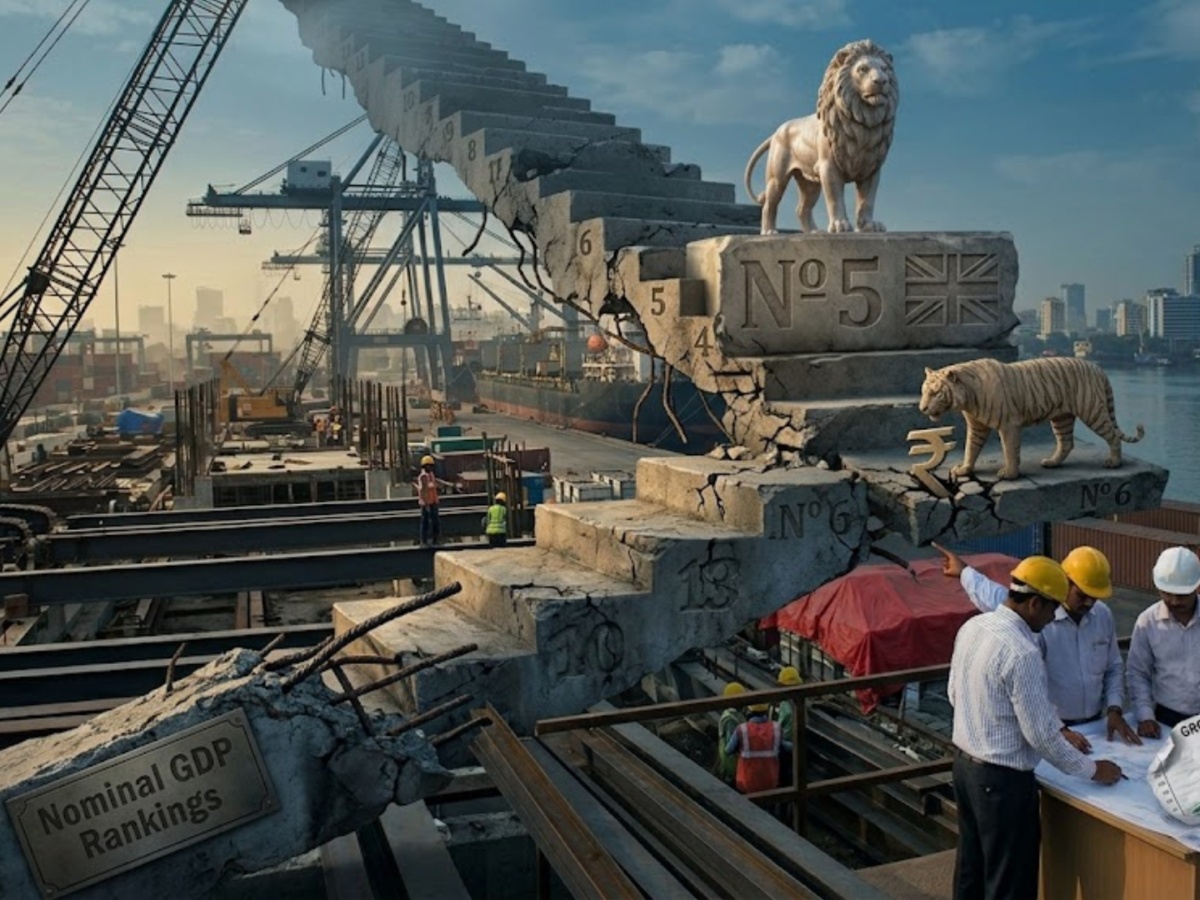

India falls down to sixth place in the IMF GDP list without being among the economically slower countries. This move is basically because of rupee depreciation, changes in GDP base, and comparison in terms of dollars. Based on projections from the IMF report from 2025-26, GDP of India is estimated to be around $3.92 trillion, which is lower than that of Japan and UK. Nevertheless, according to forecasts, India will move up to fourth place in 2027 and even overtake Japan in 2028.
India once enjoyed the fourth-largest economy status but was now ranked sixth according to revised estimates. This information appeared in the April 2026 edition of the IMF’s World Economic Outlook report.
The Indian economy was estimated to have grown to $3.92 trillion in 2025. On the other hand, the British economy had been valued at $4 trillion. Japan’s economy was still larger with $4.44 trillion. In 2024, India’s gross domestic product (GDP) was $3.5 trillion. During that year, the Indian economy outperformed Britain, whose economy was worth $3.4 trillion.
Though India had experienced a decline in its economic ranking, the country is still among the fastest-growing economies worldwide. Hence, the move should not be attributed to any economic problems.
India witnessed 9 percent nominal growth in rupees. Nevertheless, the IMF uses dollar measures for ranking countries. Such an approach makes a substantial difference.
The GDP figures need to be translated into US dollars. Hence, exchange rates play an important role in ranking countries. For example, the rupee has been depreciating from 84.6 rupees per dollar in 2024 to 88.5 rupees per dollar in 2025. The same depreciation rate is expected by the IMF for the coming year.
The GDP has grown from Rs 318 trillion in 2024 to Rs 346.5 trillion in 2025 in rupee terms. Yet, in dollar terms, its size seemed to decline because of rupee depreciation.
The impact of the GDP base year revision was also felt. The base year revision took place in February where it shifted the base year from 2011-12 to 2022-23. With this change, the way calculations were done saw reduction in nominal outputs.
According to the government figures, the nominal GDP figure for FY26 fell from Rs 357 trillion in the earlier series to Rs 345.5 trillion in the new series. Therefore, India was seen as a small economy.
The IMF also considered these changes in the forecast. Hence, India’s GDP for 2027 went down to $4.58 trillion. Previously, the estimate in October stood at $4.96 trillion.
There was a reduction in nominal GDP figures by 2.8% to 3.8% for four fiscal years starting 2022-23 and ending 2023-24. Thus, there was a decline in the size of India’s relative economy.
The fluctuating exchange rates caused additional problems. The value of the rupee recently was between Rs 94 and 95 to a dollar. Then it stabilized to Rs 93.39.
The high prices for the oil on international markets caused this situation. Besides, geopolitical tensions in the region of West Asia caused the increase in demand for dollars. Finally, foreign capital inflows negatively impacted the rupee.
To mitigate currency risks, the Reserve Bank of India interfered. Nevertheless, the depreciation affected the calculation of GDP in terms of dollars.
At the same time, the situation with the pound remained rather stable. As a result, Britain managed to keep its place. Therefore, India lost it in spite of growth.
Despite all these changes, India is anticipated to maintain its growth. According to the IMF forecasts, India will be the sixth largest economy by 2026. India’s GDP will amount to $4.15 trillion. Yet, the UK will continue holding the seventh place with GDP being $4.26 trillion.
By 2027, India can expect to occupy fourth place. As per the IMF, Indian GDP will total $4.58 trillion. UK’s economy will have GDP of $4.47 trillion.
By 2028, India will be capable of overcoming Japan. At this point, India’s GDP will total $5.06 trillion. GDP in Japan will be $4.74 trillion.
Finally, by 2031, India will occupy third place. This time GDP will reach $6.79 trillion. GDP of Japan will total $5.13 trillion.
Yet, differences between countries will be rather minimal. India will exceed UK’s economy for only $113 billion. Meanwhile, India will exceed Japan’s economy by just $17 billion.
India is set to be the fastest-growing major economy. According to the IMF estimates, GDP could hit $6.17 trillion by 2030. Such growth would narrow the distance between India and Germany.
The U.S. is expected to stay the biggest economy. Its GDP could amount to $39 trillion. China is projected to be the second-biggest one with its GDP at $27.5 trillion.
In conclusion, the change in ranking is the result of purely statistical data. The Indian economy continues growing strongly and will keep growing due to strong demographics and high internal demand.
Overall, this situation shows that movement of the currency impacts global rankings but the long-term outlook for the Indian economy is positive.