

Written By: S Kumar
CBSE New Rules for Classes 1-12 in Session 2026–27: The Central Board of Secondary Education has introduced several important reforms for the academic session 2026–2027. These changes are aligned with the National Education Policy (NEP) 2020 and aim to reduce rote learning, promote conceptual understanding, strengthen skill education, and make assessments more practical and student-friendly. The new rules impact students from Classes 1 to 12 across CBSE-affiliated schools in India.
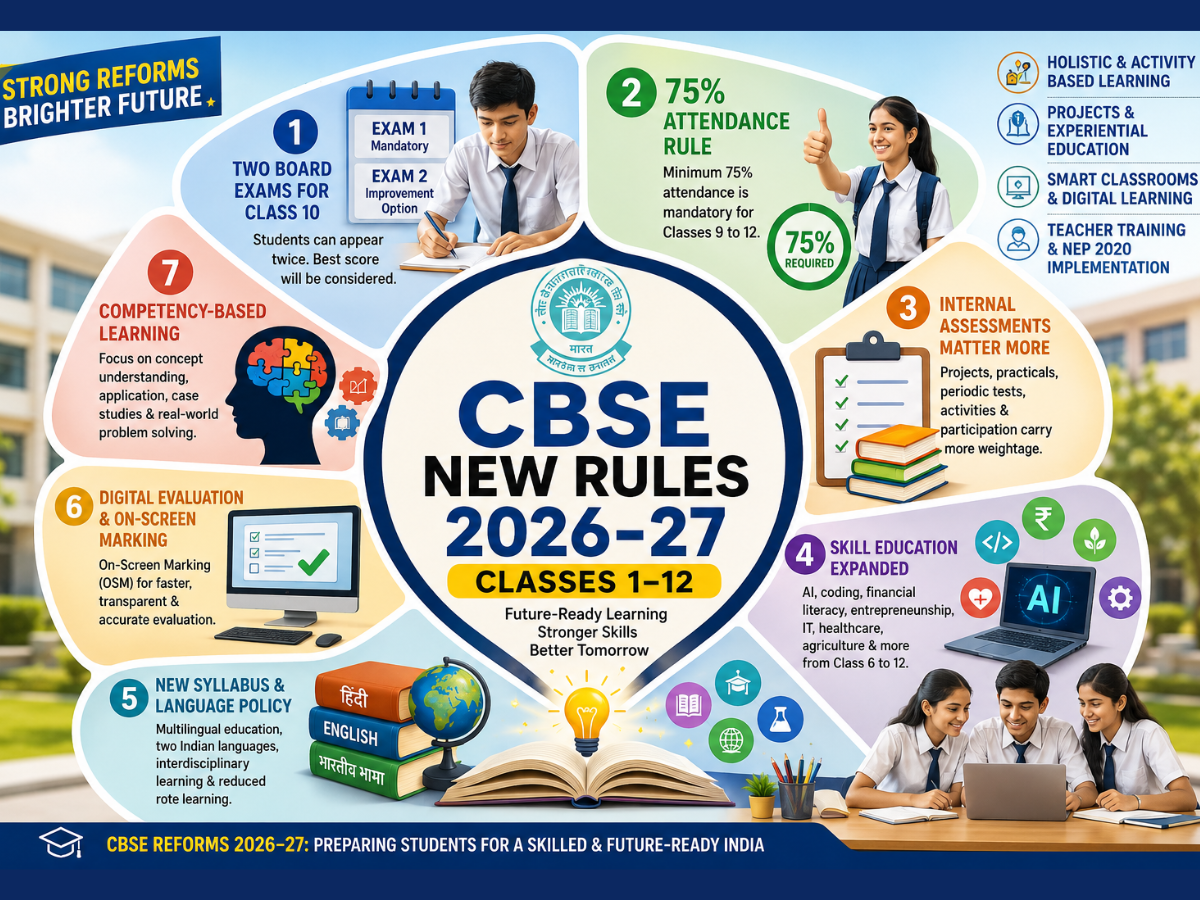
One of the key changes by CBSE is the heavier emphasis on competency-based learning and questions that look at application, not just recall. The board is slowly moving toward analytical prompts, case studies and problem-solving types in exams, instead of straightforward memorisation. Some reports indicate that in the major classes, nearly 50% of the questions will now test comprehension and real use of ideas, not mere remembering.
This is expected to help students build critical thinking, communication strengths, and real-world problem-solving ability starting from the foundational level, which is, honestly, from primary onwards.
CBSE has also introduced a rather big reform for Class 10. Students can now take the board examinations twice within a single academic year. The first test will be mandatory, and the second one will work as a chance to improve for those who want higher marks. In the end, the better score from the two attempts may be taken for final results.
The intention here is to lessen the exam pressure and give students more flexibility plus confidence so the whole cycle feels less rigid.
So CBSE has kind of made the attendance policy a bit stricter for Classes 9 to 12, maybe. Basically, students need to keep at least 75% attendance if they want to be eligible for the board examinations. Also, schools have been told to watch the attendance records very closely, along with internal assessment participation, like strictly.
Now any kind of attendance relaxation might be possible, but only in special cases, for example, medical emergencies, national-level sports participation, or other approved reasons.
The internal part, like practical work, projects, and periodic evaluations, will now matter a lot more in the overall final evaluation. CBSE seems to want schools to shift toward continuous assessment, rather than depending only on the final examinations.
Teachers are expected to assess students through things like
CBSE is also pushing skill-based and vocational education, moving it from the middle classes all the way up to senior secondary. As per CBSE’s updated curriculum framework, skill education and vocational subjects will get much more weight in Classes 6 to 12.
Students may get exposure to things such as
CBSE also plans to strengthen composite skill labs and improve the practical training setup in schools too.
The 2026–27 curriculum kinda pushes multilingual education, and it also keeps interdisciplinary learning in the picture. From what reports say, students could end up studying two Indian languages under the revised framework, while English might be handled as a foreign language option in some models, depending on how the school plans it out.
In general, the new curriculum also seems to encourage a bunch of things like flexible subject choices, cross-disciplinary learning, experiential education, real-life application of concepts, and even a reduced dependency on textbooks.
Activity-based learning, storytelling methods, foundational literacy and numeracy, experiential classroom teaching, and reduced academic pressure. There’s also emphasis on holistic progress tracking instead of exam-centric learning. The whole idea is to strengthen early education around basic reading, writing, communication, and mathematical understanding.
Now, for the subject selection part, CBSE has clarified subject eligibility, plus some additional subject rules, especially for Classes 10 and 12. Schools can only offer approved subjects if they actually have the proper teachers, infrastructure, and laboratories in place, not just on paper.
For Class 10 students, they may take extra optional subjects. But for Class 12, the additional subject choices are more limited, and it depends on school approval, along with what’s available.
Finally, there’s something about digital evaluation and on-screen marking. CBSE is introducing On-Screen Marking (OSM) to make the evaluation process more transparent, quicker, and more accurate while checking answer sheets. This digital evaluation system will be rolled out gradually for board examinations. Schools were told to improve technical readiness so everything runs smoothly when the new digital setup begins.
Students and parents are, like, actively looking around for the official CBSE Curriculum 2026–27 PDF download for updated subject guidance, assessment patterns, and the revised syllabus bits. The curriculum files for all classes are supposed to show up on the official CBSE academic website at some point in time so people don’t have to rely on random uploads.
The CBSE Class 9 syllabus for the session 2026–27 is said to include revised competency-based learning routes, hands-on experiential activities, and project-based assessment approaches. Students should download the official syllabus only from the CBSE academic portal; otherwise, you might end up with old content or “almost right” versions that confuse everyone.
For the science stream, under the new CBSE rules, the trend is expected to lean more toward practical exposure, lab work, competency-driven questions, and application-orientated teaching methods. Physics, Chemistry, Biology, and Mathematics assessments could end up with more analytical items, plus case-study-based questions.
CBSE Class 11 students may notice a stronger push for conceptual clarity, cross-disciplinary learning, and skill education. Also, subject combinations might become a little more flexible under NEP-aligned reforms, but it will depend on how CBSE frames it.
The updated Class 12 syllabus is designed to reduce pure rote remembering and instead build practical comprehension. Board exams may start testing analytical thinking more often and also real-world usage of concepts, not just theory in a line.
CBSE Class 10 syllabus changes will include competency-based questions, some flexible options around board exams, and yeah, also a lot more weight on internal assessments and projects, maybe like not just final marks.
In the years ahead, the CBSE may keep pushing a competency-based evaluation format for Classes 10 and 12. This usually means internal assessments, projects, practical exams, and periodic tests could end up counting a good deal in the final result performance, not only the written paper.
For the middle grades students might see less reliance on memorisation only and more on activity-centred learning. Classroom participation, small projects, and conceptual clarity are likely to get more attention, even if rote learning is not fully removed but sort of shifted.
Artificial intelligence, coding, data science, money literacy, and vocational education are slowly becoming more central in the CBSE framework. Schools are being encouraged to boost digital readiness and future-ready skill-building, like a broader set of capabilities rather than just textbooks.
CBSE is pushing a balanced homework policy to ease academic pressure, so schools can use practical tasks and activity-orientated assignments instead of the same type of long, repetitive written work, which honestly can feel a bit draining.
Students who show up for CBSE board examinations need to satisfy the minimum passing requirements in both theory and practical/internal checks separately. And yes, attendance rules, plus project submissions, can also quietly decide whether you’re eligible or not.
Many CBSE schools are now using digital learning, smart classroom setups, online material, and other technology-led teaching practices. The idea is to keep students more involved and make learning easier to reach for everyone.
The board has again emphasised that students must keep at least 75% attendance to be allowed to appear in the board exam. If there is any exception, it can only happen in very specific approved situations, not just because.
CBSE has also asked schools to train teachers in line with the NEP 2020 directions. Teachers are expected to use student-centric, experiential, and competency-based teaching methods in class so learning feels more guided and not just memorised.