
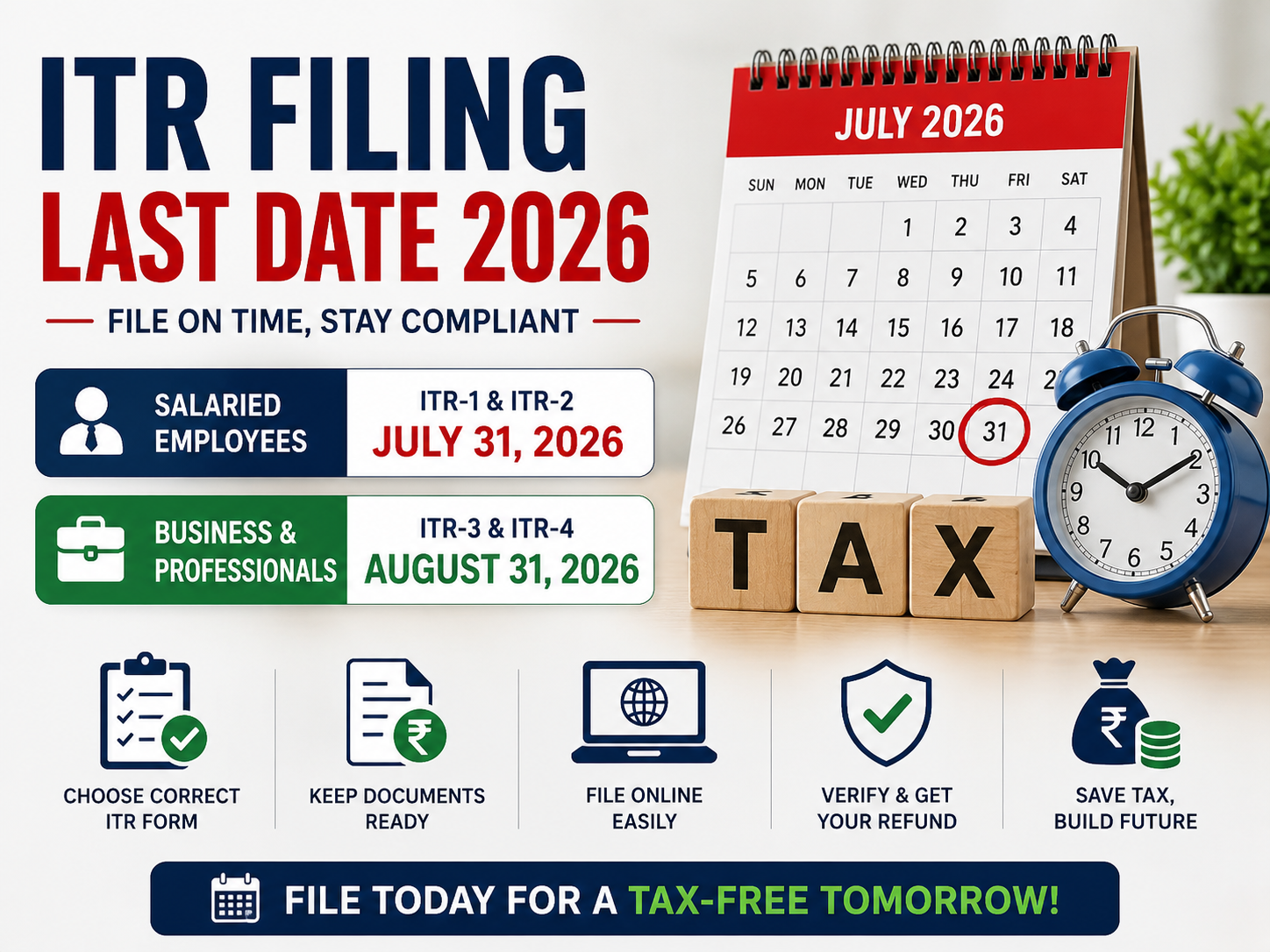

Filing your Income Tax Return (ITR) is honestly one of the most important financial duties for taxpayers in India. Whether you’re a salaried employee, a freelancer, a self-employed professional, a business owner, a pensioner, or even someone who only invests a bit, filing your ITR on time tends to keep you compliant with the tax rules. This helps you get refunds (if eligible), lets you carry forward eligible losses, and keeps your financial trail more solid for later use.
The last date for filing your income tax return actually depends on who you are as a taxpayer, and also which ITR form matches your situation.
| Taxpayer Category | Applicable ITR Form | Last Date |
|---|---|---|
| Salaried employees and eligible individual taxpayers | ITR-1, ITR-2 | July 31, 2026 |
| Non-audit business owners and professionals | ITR-3, ITR-4 | August 31, 2026 |
| Taxpayers whose accounts are required to be audited | As prescribed under the income tax Act | Applicable statutory due date |
Note: You should check the deadline for your own category carefully, because the due date may shift if the Income Tax Department announces an extension.
You may need to file an income tax return if you are:
Even if your income is below the taxable limit, submitting an ITR can still be useful, as it works as evidence for records, and it may support refund-related requests.
You can go ahead and file your ITR through the following:
For most taxpayers, online filing tends to be the quickest and also the most convenient; that’s what many people do.
Keep this in mind: your ITR is treated as successfully filed only after it has been e-verified, not just after submission.
Choosing the correct form matters a lot, like it’s essential.
ITR-1 (Sahaj)
Good for most salaried individuals, who have income from salary, one house property and other sources like interest, but only if eligibility conditions are met.
ITR-2
This works for individuals and HUFs who have capital gains, more than one house property, or foreign income / assets.
ITR-3
For individuals and HUFs earning income from business or profession.
ITR-4 (Sugam)
For eligible taxpayers opting for the presumptive taxation scheme under the Income-tax Act.
Before you file, have these documents
Yes, Form 16 isn’t really compulsory for filing your income tax return, at least in every situation.
If you did not get Form 16 from your employer, you can still fall back on documents like
These sources should help you estimate your taxable salary in a better way, without guessing.
Yes, you can, even if salary slips are not available. In that case you may use bank statements, Form 26AS, AIS, appointment letters, offer letters, employer certificates, and the EPF passbook.
If you want a cleaner record, you can ask HR or your employer for duplicate salary slips. Sometimes they keep soft copies.
Freelancers should keep organised records like a paper trail for things such as client invoices, payment receipts, bank statements, business expenses, professional tax payments, and GST returns (if you are registered).
Many eligible freelancers can also consider the presumptive taxation approach. but only if they meet the required conditions and the eligibility rules.
If you are filing as a business owner, it helps to prepare a profit and loss account, balance sheet, sales records, purchase records, expense statements, bank statements, GST returns, loan statements, fixed asset register, and depreciation details.
When your books of accounts are properly maintained, it usually improves accuracy. It also reduces the chances of getting notices.
If TDS got deducted more than what you actually needed or you ended up paying extra tax:
Once it is processed, the refund amount gets credited to your registered bank account.
Selecting the wrong ITR form, not checking AIS and Form 26AS, forgetting to report bank interest or claiming wrong deductions like these small slip-ups can get you in trouble. Add to that entering the bank account details incorrectly and missing the filing deadline. This is also forgetting to e-verify the return, and suddenly the whole process feels messy.
If you miss the due date, you may face
You can sometimes still file a belated return within the time allowed under the Income Tax Act. As long as it fits within the rules that apply.
Yes, you can revise it. If you notice an error after filing, you may file a revised return within the permitted timeline under the Income Tax Act, but only if the first return was filed within the due date that was prescribed.
Filing your income tax return on time has multiple advantages, for example:
For most salaried taxpayers filing ITR-1 or ITR-2, the due date is July 31, 2026. For non-audit business owners and professionals filing ITR-3 or ITR-4, the due date is August 31, 2026.
Yes, you can rely on Form 26AS, AIS, TIS, bank statements, and salary records to file.
No, it is kind of a helpful document, but it is not mandatory.
Yes, bank statements, Form 26AS, AIS, EPF records and employer certificates can also work.
Most eligible salaried taxpayers usually go with ITR-1. But some people may need ITR-2. They may, depending on what all the income streams are.
Business owners generally file ITR-3 or ITR-4, depending on their business type and whether they qualify under the presumptive taxation scheme.
Yes, freelancers can file their returns online using the suitable ITR form.
Just log into the income tax e-filing portal and check your filed returns section; there you can see the refund status too.
Yes, you can file a revised return within the time allowed under the Income Tax Act, as long as you notice mistakes later.
Keep your PAN, Aadhaar, bank details, Form 26AS, AIS, TIS, Form 16 (if available), investment proofs and other documents linked to income ready beforehand.