
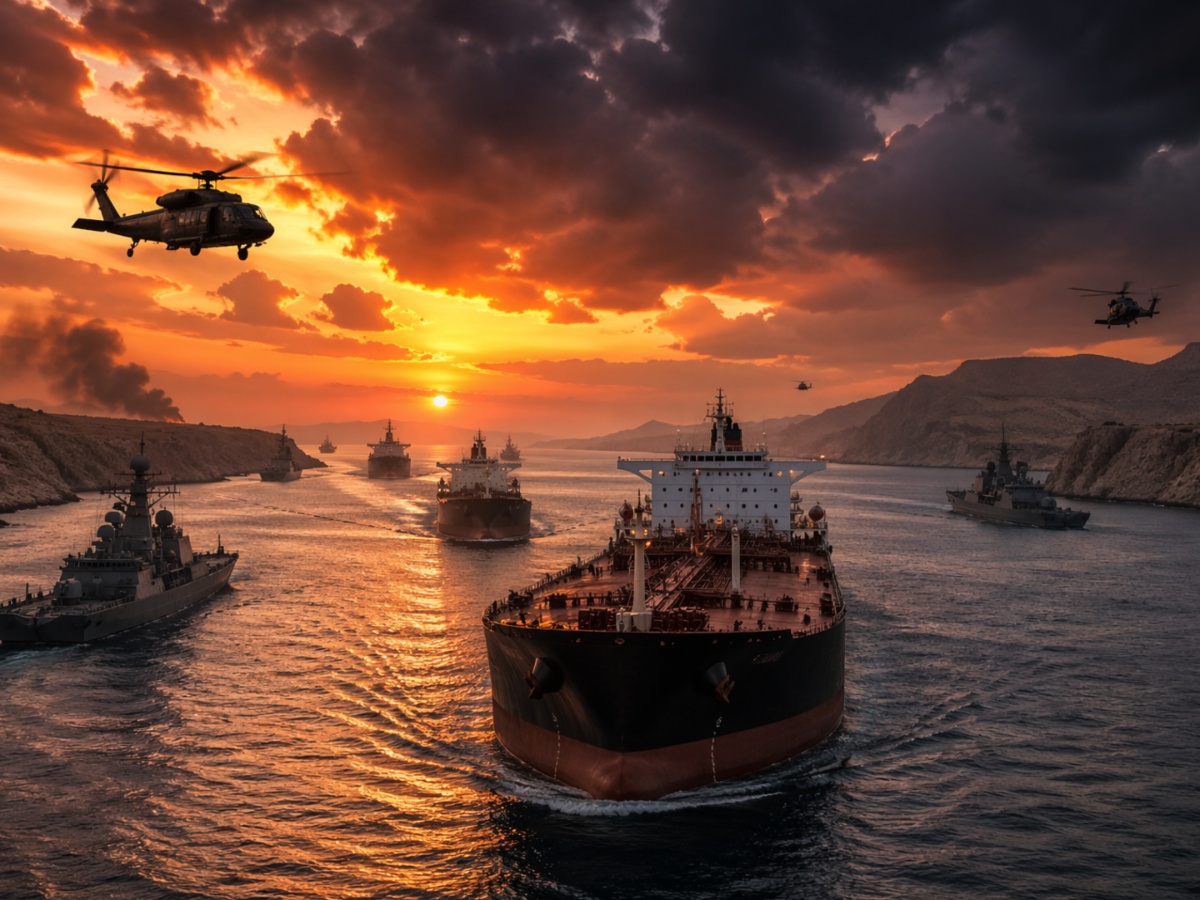

According to the recent announcement by the Iranian government, the Strait of Hormuz is now completely opened to all commercial ships. This development has sparked some optimism about possible de-escalation of the tension and stabilization of international oil markets. But conflicting announcements made by the Iranian government, American naval blockade, and the Israel-Hezbollah conflict illustrate a precarious and fragile peace. While President Donald Trump has announced that he reached an agreement with Iran, including its temporary halt in the production of nuclear weapons, Iran has failed to confirm this and other parts of the deal.
The foreign minister of Iran, Abbas Araghchi, declared that the Strait of Hormuz is “completely open” to commercial shipping. The declaration led to the rise of hope in international markets. The oil prices fell down immediately due to the prospects of re-establishment of transport links.
Nevertheless, the Strait of Hormuz was not declared fully open without any restrictions by Iran. A military spokesman said that ships need to use specified routes only. Furthermore, ships need the approval of the IRGC Navy.
On the other hand, the parliamentarian leader of Iran, Mohammad Bagher Ghalibaf, warned that should the US continue its economic sanctions against Iran, then it would be impossible to keep the Strait of Hormuz open. It was pointed out that it will be decided practically.
The US president, Donald Trump, was quick to characterize the incident as a “great and brilliant day”. The reason is that according to him, Iran promised never to shut down the strait once more. What’s more, it was reported that the country will indefinitely halt its nuclear program.
Trump also debunked any speculation regarding the $20 billion exchange agreement related to uranium. No money should be exchanged in this case, the president insisted. What’s more, the country planned to retrieve Iran’s enriched uranium that he called “nuclear dust” gradually.
Nevertheless, Iran did not verify the news, as it always insists on the right to enrich uranium inside its borders.
While an announcement about the re-opening was made, the US naval embargo of Iran persists. The American president declared that these measures will last until talks are finished entirely. Consequently, shipping organizations will be hesitant.
Very few ships are expected to transit through the strait amid existing ambiguity. The respective organizations have started to analyze the developments. The International Maritime Organization (IMO) has also started to check the possibility of safe passage.
Thus, the disruptions in the chain of energy supplies persist. The Strait of Hormuz, where one-fifth of global energy resources transits, is one of the strategic bottlenecks.
On the other hand, there is a 10-day truce in Lebanon. It has helped to decrease the tension between Israel and Hezbollah. People from Beirut and south Lebanon are coming back to their homes. The people celebrated with happiness even when they were advised not to do so.
Nevertheless, the truce is not yet strong enough. Prime Minister of Israel, Benjamin Netanyahu, explained that operations are still continuing in regard to Hezbollah. Soon after his declaration, an Israeli airstrike killed a person in southern Lebanon.
Defense minister of Israel further clarified that no troops will return to their bases. It means that the situation may change anytime again.
However, international leaders have reacted rather conservatively. France and Britain co-hosted a conference in Paris where participants from nearly 40 nations talked about measures to ensure the protection of the Strait of Hormuz and reliable maritime routes.
Emmanuel Macron, President of France, appreciated the gesture by Iran but said that the Strait should open completely and unconditionally. In his turn, Keir Starmer, Prime Minister of the UK, noted that a lasting and pragmatic approach is critical for resolution.
Anthony Albanese, Australia’s PM, also regarded it positively but underlined that the situation still was precarious and had its implications.
It’s noteworthy that Trump rejected cooperation with NATO on this issue. Instead, he criticized NATO and expressed gratitude to countries like Saudi Arabia, UAE, Pakistan, and Qatar.
The price of crude had gone up considerably due to the situation. It caused an increase in inflation and the possibility of an international recession. The reopening of the strait temporarily has relieved the pressure.
Nevertheless, uncertainties still prevail in the market. A waiver has been issued by the US Treasury to purchase Russian crude oil till 16th May. It is done with the intention to maintain stability in the energy sector.
On the other hand, Washington tries to achieve its objectives in balancing sanctions and economic considerations.
Recent developments have seen an escalation in diplomacy. Pakistan has been active as a mediator. Army Chief Asim Munir is in Tehran to help broker peace.
Stability in Lebanon continues to be an essential part of future negotiations. Meanwhile, the ongoing ceasefire agreement with Iran is scheduled to end shortly.
Casualties are mounting from the conflict. Casualties on both sides are numbering into thousands in Iran, Lebanon, Israel, and the Gulf countries. Even the Americans have not been spared any loss.
The opening of the Strait of Hormuz is a positive sign. But contradictions still abound in terms of what is said versus what is being done on the ground. Military, political, and economic tensions continue to cloud the situation.
There have been some reprieves for now but until there is a firm peace deal in place, things can get quite volatile anytime.