
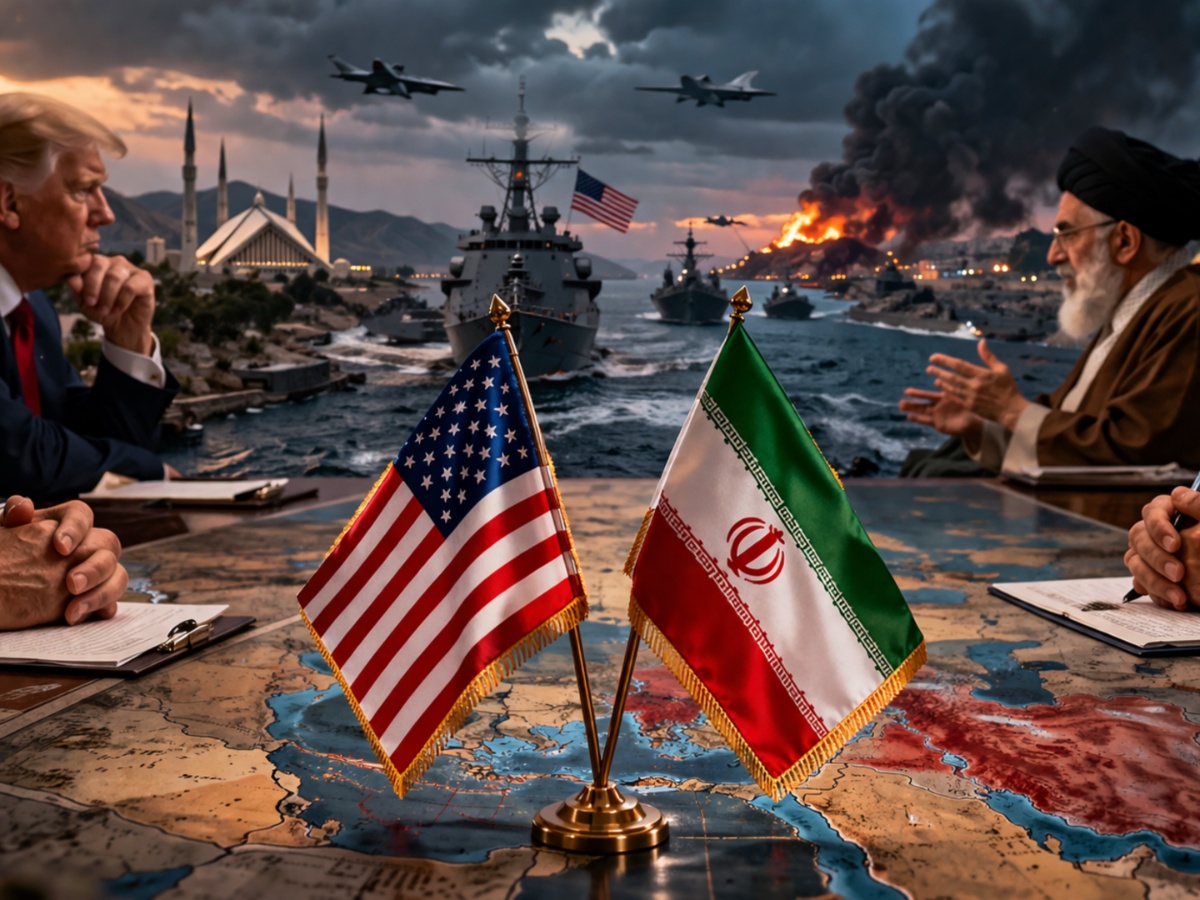

US-Iran ceasefire talks held in Islamabad failed as neither party was able to come to an agreement after almost 21 hours of tough negotiations. The talks have been considered as the most important face-to-face negotiations between the two nations in more than ten years. US Vice President JD Vance returned from Islamabad without any peace treaty in hand because Iran rejected a proposal made by the United States that asked them to give up their ambitions related to nuclear weapons permanently. Issues such as nuclear limitations, sanction lifting, passage through the Strait of Hormuz, compensation for damages of war, and release of frozen Iranian assets were among those disputed during the negotiations.
The main reason why the discussions in Islamabad failed was that there were differences over Iran’s nuclear program. The Americans insisted on a long-term promise from Iran that it will forego its pursuit of nuclear weapons. But Iran did not agree to that.
JD Vance did not say anything about what transpired in those 21 hours of talks. But he pointed out the most important aspect of the discussions. As Vance put it, “We need a commitment from Iran not to develop nuclear weapons.” According to him, this was one of the objectives of President Donald Trump. And this was an objective that the Americans sought all along during the discussion process.
According to Vance, the question is, “Did Iran demonstrate the kind of commitment to give up their weapons of mass destruction?” And the answer to this was, “No.”
Vance also said that American forces have already dismantled Iran’s enrichment capabilities. And according to him, the question was no longer capability but intention. But apparently, the Iranians refused to address this matter.
The spokesperson for Iran’s Ministry of Foreign Affairs, Esmaeil Baghaei, stated that the negotiations involved several delicate topics. They included the Strait of Hormuz, Iran’s nuclear program, sanctions’ rollback, war reparations, and ending the state of hostility.
Iranian officials stated that the negotiation sessions involved:
Washington outlined a list containing 15 proposals. The list mainly covered limitation of Iran’s nuclear programme and re-opening the Strait of Hormuz. In its response, Tehran put forward a 10-item counter-proposal. According to the counter-proposal, Iran sought to get guarantee of an end to the war, control of the Strait of Hormuz, damages incurred from US-Israeli attack, and unfreezing of Iran’s money in foreign banks.
According to JD Vance, the issue of frozen Iranian assets was discussed by the negotiation team. But he maintained that the key issue of concern had not changed at all. He asserted that Iran did not accept the conditions set out by America.
In its statement, Iran’s national broadcaster IRIB attributed the collapse to Washington. It added that the Iranian delegates worked round the clock for 21 hours.
Vance denied that Washington was being rigid about the talks. According to him, the US negotiating team entered the discussion with good intentions. Vance stated that the president had tasked his men with making a concrete effort to reach an agreement.
According to him, the US negotiation stance was flexible. He noted that the US delegation also made clear its red lines on which it would not bend. However, he maintained that the Iranians did not accept their proposals.
Thus, according to him, the talks had failed due to Iran’s intransigence.
Some experts argued that Iran chose to be stubborn because it was aware that time was on its side. According to Iranian sources, Iran did not expect any agreement because of the unrealistic expectations held by Americans.
Washington could not reduce its demands even after considering the realities of the battlefields. According to Alex Plitsas, a CNN national security analyst, Iran felt very confident. Iran will stick to its stance unless its perception changes.
According to an official familiar with Iran’s negotiations, Iran perceived the negotiations differently. The official said that the US was eager to conduct the negotiations for its own image abroad. It should be noted that Iran was defending its achievements in the battlefields.
The situation in the Strait of Hormuz remains unchanged. According to a Tasnim news source, Iran does not intend to change anything unless America offers Iran a fair bargain.
Iran showed that it was not going to negotiate again. According to an official from the Iranian side, Tehran did not plan on continuing the negotiations.
The issue of the US offer remains open. Nevertheless, Iran’s Ministry of Foreign Affairs took a somewhat more flexible stance. The spokesman for the ministry, Esmaeil Baghaei, stated that diplomacy could be considered. However, he did not express readiness to resume the negotiations.
The question of further confrontation seems quite open-ended at the moment. When a reporter asked JD Vance if America was returning to the battlefield, he left the area without responding.
President Donald Trump brushed off worries over contingency planning, asserting that the military power of Iran had dropped substantially. According to Trump, US forces severely hit the military infrastructure of Iran.
The President emphasized that Iran does not have many missiles and production capacity. In addition, Trump praised US military performance, claiming that American forces acted superbly.
A two-week cease-fire ordered by Trump is still in force. Nevertheless, there is no deal in place yet and no follow-up talks are planned, while the Strait of Hormuz is blocked. Iran displays no hurry to begin negotiations.
Thus, the space for diplomacy narrows down gradually, with the collapse of Islamabad talks casting another shadow over the future prospects.