
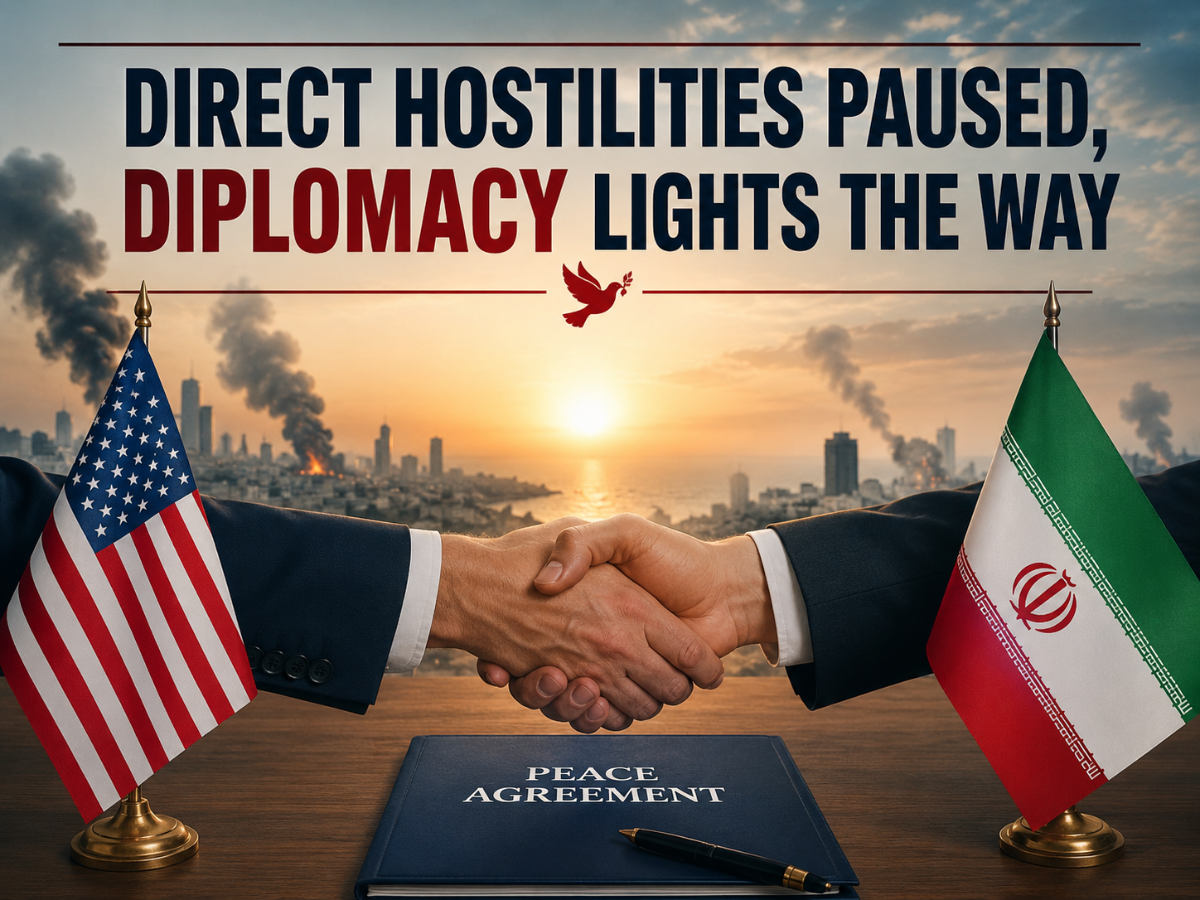

US–Iran War Peace Deal Update: After months of Middle Eastern military war, conflict, tensions, missile exchanges, and disruptions to global shipping routes, the US and Iran have signed a peace framework. This refers to pausing direct hostilities. Anyhow, the war has not ended entirely, but the agreement looks like a big diplomatic breakthrough; violence did not just vanish from the region.
As of now, the direct confrontation between Washington and Tehran is likely to stop under a newly signed 14-point Memorandum of Understanding (MoU) agreement. But checking on ongoing clashes involving Israel and Hezbollah, along with unresolved nuclear issues, means the wider regional crisis remains unsettled.
This came after weeks of diplomacy with regional and international mediators involved. The US and Iran electronically signed a 14-point MoU, basically built to pause military activity and form a kind of working roadmap for later negotiations.
The deal is mostly about lowering the temperature, restarting key maritime routes, and laying out a path for talks related to sanctions and Iran’s nuclear programme. It’s not a final peace treaty, of course, but it does feel like a meaningful move toward broader regional stability.
Unlike the traditional peace accords that get signed in big public ceremonies, the deal was finalised a bit differently; it was completed electronically, via diplomatic channels, more or less.
The following phase of talks was meant to happen in Buergenstock, Switzerland. There, officials planned technical discussions on putting the agreement into practice. But later, those sessions were postponed due to fresh fighting in Lebanon, unexpectedly enough.
A range of governments and senior officials had meaningful roles in pushing the agreement forward.
On the US side, personnel from the White House, the State Department, the Pentagon, and the Vice President, JD Vance’s, office took part in the negotiations. On Iran’s side, the team worked under President Masoud Pezeshkian while also coordinating with top leadership in Tehran through a steady line.
Qatar served as the major mediator; it helped move messages between the parties. Switzerland, meanwhile, agreed to host additional talks later, when things could be scheduled again.
One of the main results of the agreement is the end of direct military clashes between the US and Iran.
while both the countries have now committed to avoiding further attacks. but pursuing diplomatic solutions. Hence, their framework has also established a 60-day negotiation period to address complex issues. This includes issues like sanctions relief, nuclear restrictions, and long-term security arrangements.
Key provisions of the agreement include:
These measures are intended to create conditions for broader negotiations.
Despite some progress between Washington and Tehran, violence kind of ramped up again in southern Lebanon on June 19.
After the Hezbollah attacks, Israeli airstrikes hit multiple locations, which were reported to have caused Israeli military casualties. While this escalation underlined how hard it is to build broader regional peace even after the US-Iran agreement.
To prevent further escalation, US and Qatari mediators worked with regional officials to secure a localised ceasefire between Israel and Hezbollah.
The ceasefire reportedly took effect on June 19 and is intended to halt cross-border attacks and stabilise southern Lebanon. However, concerns remain about how long the truce will hold.
If you knew about the next round of diplomatic discussions, it was scheduled to begin in Switzerland on June 19.
But Iran postponed sending its delegation after the escalation in Lebanon, arguing there was no immediate urgency. This is because the broader framework agreement had already been signed.
Both sides have said negotiations will be rescheduled, sooner or later.
Also, the delay meant Vice President JD Vance cancelled travel plans connected to the talks.
The Strait of Hormuz is among the world’s most important energy passageways, moving a large share of global oil exports.
During the conflict, fears about disruptions to shipping created a lot of uncertainty in international energy markets. The agreement is designed to bring back normal maritime traffic, and to improve trust among global traders and shipping firms.
Although military tensions have eased, major issues remain unresolved.
The agreement establishes a 60-day period during which negotiators will focus on Iran’s nuclear activities, including enrichment limits, inspections, sanctions relief, and verification measures. The outcome of these talks could determine whether the current truce becomes a lasting peace arrangement.
The agreement has generated mixed reactions within Iran.
While President Masoud Pezeshkian has supported the framework as a way to prevent a broader conflict, some political and military figures remain cautious. Iranian officials have also warned that Tehran could respond if it believes the US fails to honour its commitments.
Although the direct US-Iran war has been paused, several regional flashpoints remain active.
Israel’s security concerns, Hezbollah’s military activities, regional rivalries, and unresolved nuclear disputes continue to create uncertainty. Any major incident could threaten the fragile diplomatic progress achieved so far.
As of now, direct US-Iran hostilities have paused under a new peace framework. However, regional tensions persist, with ceasefires still fragile.
Here are the major negotiations on sanctions, nuclear issues, and security ahead. The next 60 days will be critical for lasting peace.